
I recently took part in an academic conference in Lisbon where I presented a paper about the notion of science literacy in eighteenth-century Britain. In this paper, I endorsed a knowledge-based notion of science literacy. I argued that attempts to promote (and acquire) science literacy should focus on communicating (and learning) knowledge.[1] Science literacy is not exclusively about having knowledge but, I argued, knowledge lies at its core.
I had done some work on science literacy a few years ago, but what prompted me to think in this direction again was a recent short study I conducted into the kind of notion of science literacy that eighteenth-century popular science writers promoted in their works. These writers didn’t use the term ‘science literacy’ but from the design, aims and content of their works we can infer how they understood the concept. To cut a long story short, popularisers aimed to communicate scientific knowledge in a structured and coherent format, elucidate the broader implications of that knowledge and do all this in a way that was as accessible as possible. Acquiring science literacy in the eighteenth century meant, essentially, acquiring systematic knowledge in and about science. Notably, this was also the period during which Britain experienced an unprecedented growth in public interest in science.
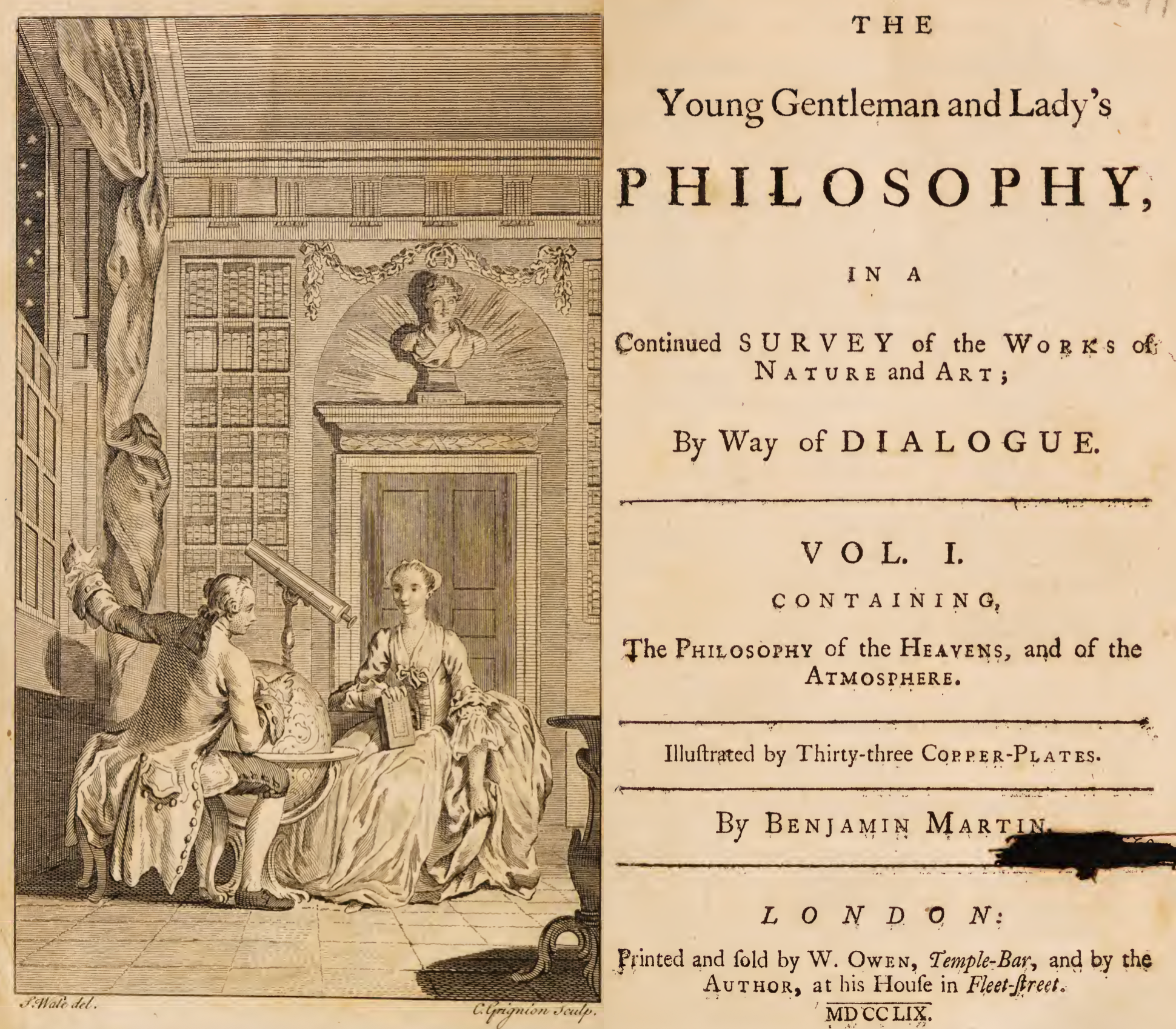
Benjamin Martin was one of Britain’s foremost eighteenth-century science popularisers. His The Young Gentleman and Lady’s Philosophy (2 vols. 1759) comprises an astonishing 91 dialogues between a scientifically educated Gentleman and a scientifically curious Lady. Through a series of discussions with the Gentleman, the Lady learns about cosmology, geography, pneumatics, electricity, astronomy, optics and acoustics. She learns scientific subjects, not some curious, isolated facts.
In the course of this research, I found that a knowledge-based conception of science literacy sits uneasily with much current thinking. One important reason is the spread of ‘social constructionism’ which puts less emphasis on science as knowledge than on science as a social practice, and focusses on critical engagement with science and on the socially situated character of scientific knowledge.
Under the influence of social constructionist views, much contemporary discussion of science literacy has shifted away from knowledge and towards skillsto think critically about science – its impact on society, its political implications, the risks it poses etc. This is sometimes called ‘Vision III’ science literacy’.[2] Social constructionist views have also come to dominate in education policy – a detailed study by Michael Matthews explains part of the story of how this came to be in science education, while a book recently published by Lindsay Paterson explores the adverse consequences of adopting such views as the broad basis for the curriculum in Scottish schools. [3] Social constructionist ideas are also shaping university pedagogy – when composing a list of ‘Intended Learning Outcomes’, for instance, conveners are advised to avoid verbs such as ‘to know’ and ‘to understand’ which, it is argued, are vague and unmeasurable. Conveners are encouraged to use ‘active’ verbs instead referring to specific skills, such as ‘to write’, ‘to justify’, ‘to describe’, to ‘think critically’, to ‘manage’, to ‘select’ and so on.[4]
While some of the goals of social constructionism may be laudable, the question remains: How can the skills that social constructionism wants people to exercise be properly exercised without knowledge? How can one reason, create, be critical or do anything at all without having acquired a solid knowledge base first?
[1] By ‘knowledge’ I mean systematic knowledge about a subject. Systematic knowledge need not be comprehensive, but it is organised in a framework in which it all makes sense. Knowing curious facts about animals, for example, is not the same as having systematic knowledge of animal life.
[2] Valladares, L. (2021) ‘Scientific Literacy and Social Transformation’, Science & Education 30, 557–587. Available at: https://doi.org/10.1007/s11191-021-00205-2
[3] Matthews M. R. (2022). ‘Thomas Kuhn and Science Education: Learning from the Past and the Importance of History and Philosophy of Science’, Science & education, 1–70. Available at: https://pubmed.ncbi.nlm.nih.gov/36531747/ Paterson, L. (2026). Lessons from Scottish Schools. Edinburgh: Edinburgh University Press. See https://edinburghuniversitypress.com/book-lessons-from-scottish-schools.html
[4] Such guidelines can be found on the websites of many universities:
https://teachinghub.bath.ac.uk/guide/individual-learning-outcomes-action-verbs/
https://www.bristol.ac.uk/academic-quality/approve/intendedlearningoutcomes
https://academicaffairs.oregonstate.edu/student-learning-outcomes-measurable-actions
See also this paper by Winwood and Purvis (2015): https://shura.shu.ac.uk/32056/1/A%20Guide%20to%20Writing%20Learning%20Outcomes%20in%20Higher%20Education%20-%20NTR%20.pdf