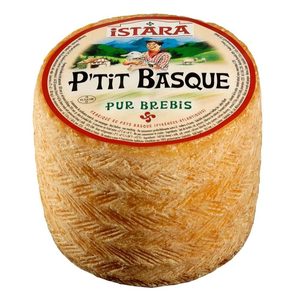
I like cheese almost as much as I like maths. A few weeks ago, I bought a wheel of P’tit Basque cheese from the local supermarket. The cheese is French (!) but the wheel is, indeed, petit, which is why P’tit Basque is often sold as a whole wheel. Looking at it on the cheese board set me thinking about the best way to remove the curved side rind, which is inedible, without wasting too much cheese. Using a straight cheese knife to remove large chunks of the curved rind would inevitably result in sacrificing a generous layer of perfectly good cheese with it. So, instead, I cut the wheel into quarters, sliced each quarter into thin wedges and removed the rind from each wedge individually.
Removing the rind from a thin wedge is much less wasteful because each cut only has to follow a small arc of the curve and at that scale the rind is nearly flat. The thinner the wedge, the better a straight cut approximates the curve and the less cheese gets wasted. At this point, a mathematician might add that taken to the limit (that is, as the wedges become ‘infinitely thin’), the error in our approximation would tend to zero.
No cheese actually gets cut into infinitesimals, of course. But it struck me that my little cheese experiment might be a rather good way of introducing young maths students (especially those who like cheese!) to some of the fundamental ideas behind calculus.
One of these ideas is local linearity – smooth curves increasingly look like straight lines when we zoom in far enough. We apply this logic to arc length where a curved path is approximated by a chain of short straight segments, and in differentiation where we determine the slope of a curve (how steeply a curve is rising or falling at a single point) by zooming in until the curve is increasingly well approximated by its tangent line (a straight line that touches the curve at that point). The same general strategy of breaking up complicated objects into small pieces applies in integral calculus where we use Riemann sums – a method for approximating the area under a curve by adding up small narrow rectangles. As the rectangles become thinner, the approximation becomes more accurate and the exact area under the curve is defined as the limit of that process.
So, perhaps, there is more calculus lurking on the cheese board than one might expect. Who would have guessed that maths could be so cheesy?